Linked to the accepted samples, method and reporting conditions. No duplicate output charge.
Material Properties · Tribology & Deformation
Dynamic Mechanical Analysis (DMA)
Characterise viscoelastic behaviour through storage modulus, loss modulus and damping under an agreed deformation and temperature/frequency programme.

- Price
- from£105 per independent standard run per sample, excl. VATA £45 service fee applies to orders under £300, excluding VAT.
- Turnaround
- 8–12 working days Preparation and scope dependent
- Available platforms
- TA Instruments Discovery DMA 850NETZSCH DMA 303 EplexorHitachi NEXTA DMA200PerkinElmer DMA 8000
- Typical outputs
- DMA modulus and damping curvesAgreed transition and modulus tableGeometry, fixture and programme record
What DMA can help you understand
Characterise viscoelastic behaviour through storage modulus, loss modulus and damping under an agreed deformation and temperature/frequency programme.
Choose the measurement scope
- Temperature-dependent viscoelastic response
- Frequency-dependent response
- Agreed transition comparison
Master curves and time-temperature superposition require a separately accepted acquisition and processing scope. DMA is not a general tensile, hardness or friction/wear test.
Your agreed result package
Linked to the accepted samples, method and reporting conditions. No duplicate output charge.
Linked to the accepted samples, method and reporting conditions. No duplicate output charge.
Master curves and time-temperature superposition require a separately accepted acquisition and processing scope. DMA is not a general tensile, hardness or friction/wear test.
Example results
What DMA results can look like
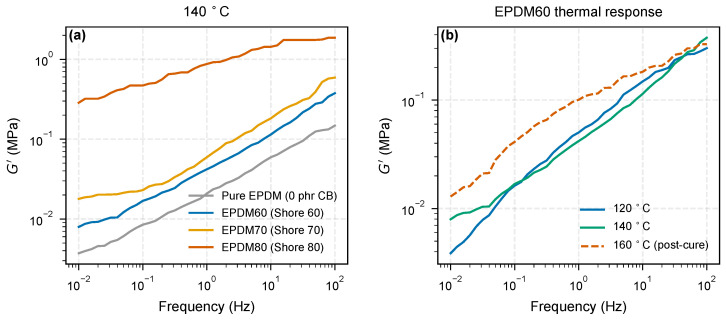
The plot shows dynamic mechanical analysis of EPDM/CB compounds. Storage modulus G ′ ( ω ) at 140 °C.
Yancai Sun et al. · source · CC BY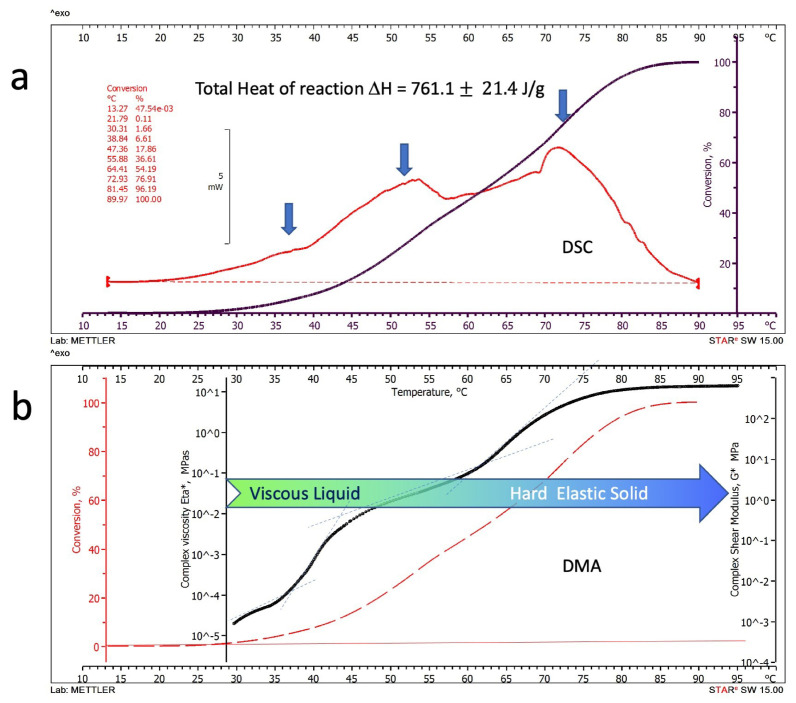
The plot shows parallel thermal scan thermograms of the alkaline-activated Metakaolin paste heated at 1 °C/min.
Raffaella Aversa et al. · source · CC BYPrepare your samples
Provide specimen dimensions, material, fixture/deformation preference, temperature and frequency ranges, conditioning and the intended comparison.
Do not dispatch restricted or unstable material before acceptance. The quotation and shipping instructions confirm the receiving location and any cross-border constraints. Shipping time is additional to laboratory turnaround.
Planning questions
What should I prepare?
Provide specimen dimensions, material, fixture/deformation preference, temperature and frequency ranges, conditioning and the intended comparison.
What is outside the standard scope?
Master curves and time-temperature superposition require a separately accepted acquisition and processing scope. DMA is not a general tensile, hardness or friction/wear test.
When does turnaround begin?
8–12 working days is the indicative laboratory period after technical acceptance and receipt of all required samples and information. Preparation, special conditions and shipping can extend the overall schedule.
Configure the service
Send the information needed to scope DMA correctly
- Sample form, material, dimensions and quantity
- Feature or decision the result must address
- Required comparison, acceptance criterion or reference
- Preferred output and reporting depth
DMA analysisfrom£105
A £45 service fee applies to orders under £300, excluding VAT.
Typical turnaround: 8–12 working days
Configure & Book