Select a defensible element type, mesh strategy, and solver.
Linear static, contact, and nonlinear analysis
Modelling & Data · Numerical Modeling
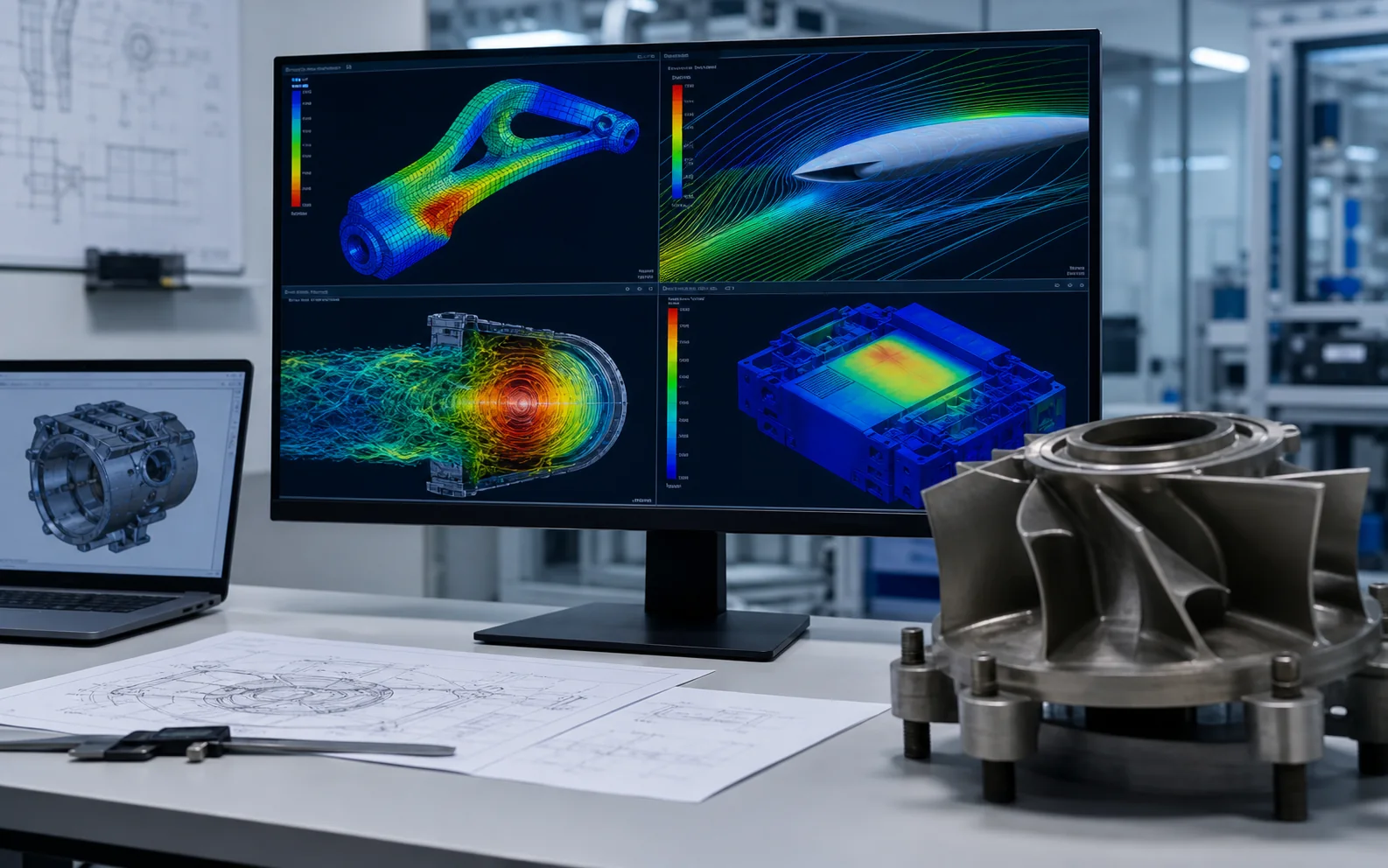
Finite element analysis predicts structural response before physical testing by discretising a component or assembly and solving for stresses, strains, displacements, reactions, stability, or dynamic behaviour under defined loads.
Why this service
Finite element analysis predicts structural response before physical testing by discretising a component or assembly and solving for stresses, strains, displacements, reactions, stability, or dynamic…
Linear static, contact, and nonlinear analysis
Modal, buckling, transient, or explicit dynamics
Mesh-convergence and sensitivity checks
Choose the scope
The method, preparation route and reporting depth depend on what you need to decide.
Select a defensible element type, mesh strategy, and solver.
Separate numerical artefacts from credible structural hot spots.
Define the minimum physical validation needed for the model.
Common outputs
Fields, conditions, processing and file formats are confirmed before work begins.
A representative output from Finite Element Analysis (FEA) with agreed units, labels, and revision status.
Checks, tolerances, convergence, uncertainty, or inspection evidence appropriate to the service.
A concise interpretation connecting the deliverable to the customer decision.
Input requirements
Provide representative, clearly labelled inputs and identify the decision, feature or comparison that matters.
| Suitable input | Submission requirement | Planning note |
|---|---|---|
| Project input or design file | Provide the current design, objective, constraints and required deliverables for technical review. | Declare confidentiality, file, access or delivery constraints in advance. |
Objective: state the decision, comparison or acceptance criterion the work must support.
Handling and access: declare hazards, instability, confidentiality, file constraints or special logistics before dispatch or transfer.
Questions and answers
Short answers to issues that can change preparation, scope, timing or interpretation.
A clean CAD model or dimensioned geometry, with the required units and coordinate system.
Start with Linear static, contact, and nonlinear analysis; the final option is confirmed against the required decision and acceptance criteria.
Typical outputs include stress and strain contours, displacement and reaction forces, safety-factor findings. Final files follow the confirmed reporting scope.
Delivery timing is confirmed after the project inputs, scope and dependencies have been reviewed.
Request a project quotation