What resistance comes from the interface?
Interface resistance assessment
Performance Testing · Thermal Analysis
Evaluate resistance to heat flow across a material interface. Agree the contact surfaces, specimen geometry, temperature and loading conditions before comparing thermal resistance or conductance.
Why this service
An interface can restrict heat transfer even when the adjoining materials conduct heat well. TESTDOG reviews the contact or layer structure and defines what the measurement can separate and report.
Interface resistance assessment
Contact-condition comparison
Material or assembly comparison
Choose the scope
The method, preparation route and reporting depth depend on what you need to decide.
What resistance comes from the interface?
How do contact conditions affect heat flow?
Which interface material performs better?
Common outputs
Fields, conditions, processing and file formats are confirmed before work begins.
Thermal resistance on an agreed basis reported with the agreed units, sample reference and measurement conditions.
Derived conductance where applicable supplied in a labelled format suitable for direct sample or condition comparison.
Material or condition comparison provided with the processing basis and quality checks agreed during technical review.
Geometry, loading and method notes included when selected in the confirmed reporting scope.
Example results
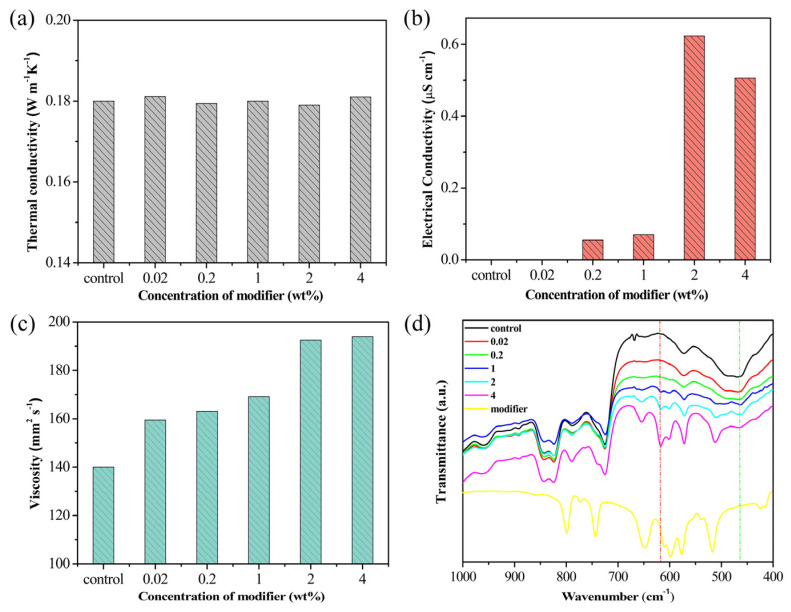
The plot shows effect of modifier concentration on the thermal conductivity, electrical conductivity, viscosity, and FTIR spectra.
Yihua Qian et al. · source · CC BY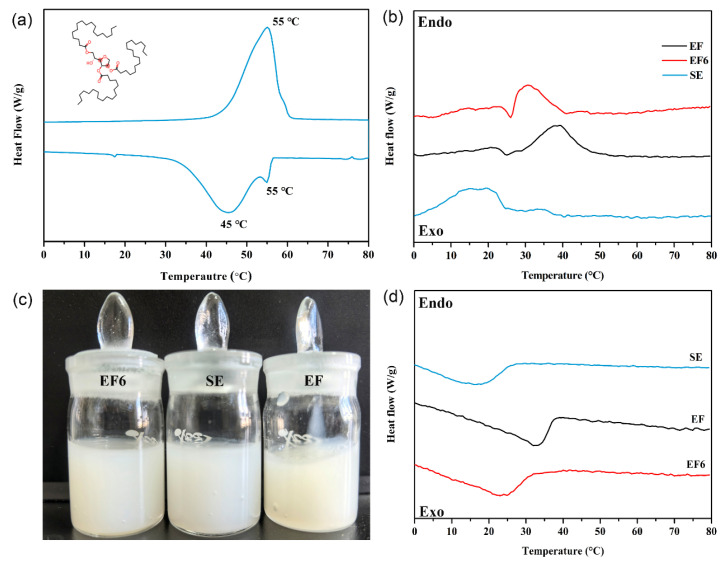
The plot shows dSC thermograms of Span65 and its physical state and thermal behavior when dispersed in different base fluids—SE.
Yihua Qian et al. · source · CC BYSample requirements
Provide representative, clearly labelled samples and identify the decision, feature or comparison that matters.
| Suitable sample | Submission requirement | Planning note |
|---|---|---|
| Mating solid surfaces | Describe both materials, contact area, flatness, roughness and the intended assembly load. | Agree surface preparation, mounting and contact conditions before testing. |
| Thermal interface pads or sheets | Provide composition, thickness, contact dimensions and any compression or conditioning history. | Confirm specimen geometry and whether bulk and contact contributions need separation. |
| Layered specimens | Provide layer sequence, thicknesses, substrate and the interface of interest for feasibility review. | Thin-film boundaries may need a different route from macroscopic contact measurements. |
Objective: state the decision, comparison or acceptance criterion the work must support.
Handling and access: declare hazards, instability, confidentiality, file constraints or special logistics before dispatch or transfer.
Questions and answers
Short answers to issues that can change preparation, scope, timing or interpretation.
No. Bulk conductivity describes heat transport within a material. Interface resistance concerns transfer across a boundary or contact; a whole-assembly measurement can contain both contributions.
For contacting surfaces, loading and surface condition can change effective contact and the measured resistance. Specify the assembly conditions that the test should represent.
Agree the required quantity and units before testing. Conductance is the reciprocal of resistance on the same area basis; the report identifies any area normalisation and derivation.
Provide the standard and edition with your enquiry. ASTM D5470 addresses thermal transmission properties of relevant insulation materials; sample and method applicability require technical review.
Send the layer structure, thicknesses and substrate details for feasibility review. A thin-film boundary may require a different measurement route from a macroscopic contact or interface pad.
Typical turnaround is 8 working days after sample acceptance and method confirmation.
Configure the service
A £45 service fee applies to orders under £300, excluding VAT.
Typical turnaround: 8 working days
Configure & Book